
As one of the most popular sports globally, cricket has several tournaments which get quite competitive when you have more than two teams with the same number of points. In these scenarios, the Net Run Rate(NRR) becomes an important factor to calculate which team will make it through. This is precisely why fans, players and analysts often make use of an Net Run Rate Calculator to wrap their head around the current team positions and qualification situation.
This article will convince you as to what NRR(Net Run Rate) is, how does the NRR calculator works and so on including but not limited to net run rate formula & also if it leaves any curiosity over how net run rate is calculated in cricket.
🏏 Net Run Rate-NRR Calculator 🧮
🏏 Net Run Rate Calculator
Calculate your cricket team’s NRR instantly
Your Net Run Rate
Bowling Run Rate:
What is Net Run Rate(NRR)?
NRR (Net Run Rate) is a cricketing statistic used to rank teams on equal points in the same tournament. It measures how efficiently a team scores runs compared to its speed of running (i.e., pace) at which it concedes runs.
To put it in layman terms Net Run Rate reflects how a team is performing as compared to its opponents over the course of an entire tournament.
Nov 5, a team has higher NRR than the other if both have same points.
Example
Say if Team A scores runs really fast and restricts opposition from scoring faster. Its NRR will be positive.
However, if Team B scores very slowly and lets the opponents score quickly then its NRR may become -ve.
Here is because of which NRR end up being deciding factor in tournament like:
- ICC Cricket World Cup
- ICC T20 World Cup
- Indian Premier League (IPL)
- Champions Trophy
- Domestic Cricket Leagues
NRR Full Form | What Does NRR Stand For?
The cricket lover know the full form of NRR, but many people search on google about NRR in Cricket, Let’s reveal this, the NRR Stand for NRR = Net Run Rate
It represents the difference between:
- The average runs scored per over by a team.
- The average runs conceded per over by a team.
A positive NRR indicates strong performance, while a negative NRR suggests weaker performance compared to opponents.
What is an NRR Calculator?
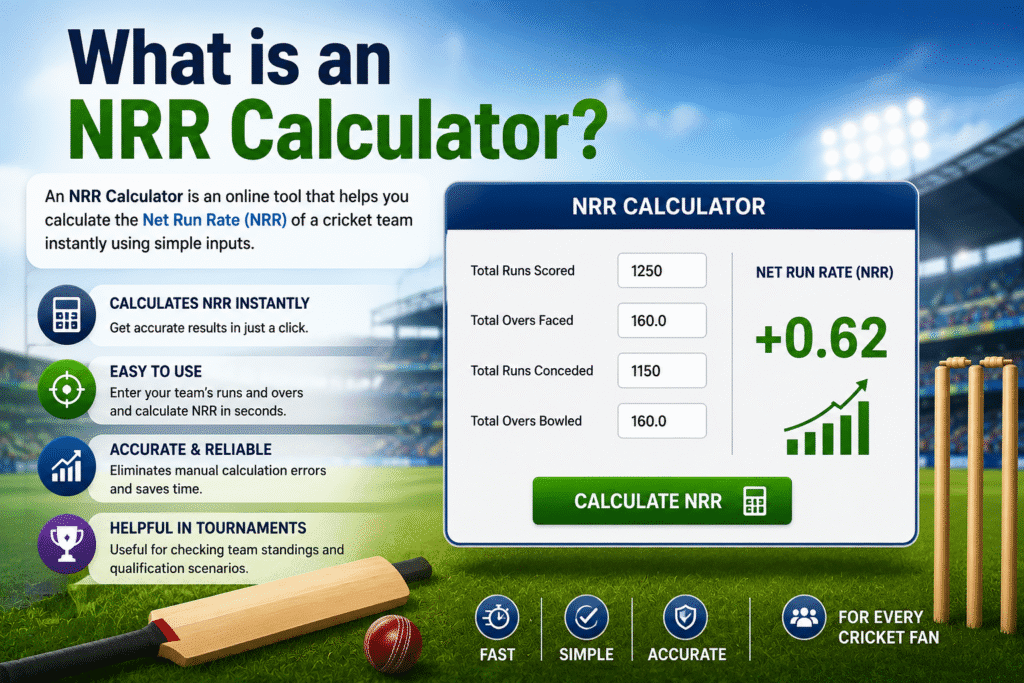
NRR Calculator is a tool to calculate the Net Run Rate of your cricket team automatically.
Without having to calculate manually how many various runs and overs from a match, Users can enter:
- Total runs scored
- Total overs faced
- Total runs conceded
- Total overs bowled
You get an instant Net Run Rate of the team via calculator.
Benefits of an NRR Calculator
- Saves time
- Eliminates calculation errors
- Helps understand qualification scenarios
- Useful during tournaments
- Easy for cricket fans and analysts
During the different major competitions such as the ICC World Cup or T20 World Championship, most cricket websites and apps use NRR (Net Run Rate) calculators at some point to predict hopes of progression.
Net Run Rate Calculator And Net Run Rate Formula
The formula used to calculate Net Run Rate is: NRR = \frac{Total\ Runs\ Scored}{Total\ Overs\ Faced} – \frac{Total\ Runs\ Conceded}{Total\ Overs\ Bowled}

Formula Explained
Run Rate Scored
= Total Runs Scored ÷ Total Overs Faced
Run Rate Conceded
= Total Runs Conceded ÷ Total Overs Bowled
Net Run Rate
= Run Rate Scored − Run Rate Conceded
The final value can be positive or negative.
How to calculate net run rate in cricket?
Many cricket fans wonder: How is Net Run Rate calculated in cricket? Let’s understand with a simple example.
Example Calculation
Suppose a team has played 5 matches.
Batting Statistics
- Total Runs Scored = 850
- Total Overs Faced = 100
Run Rate Scored:
850 ÷ 100 = 8.50
Bowling Statistics
- Total Runs Conceded = 780
- Total Overs Bowled = 100
Run Rate Conceded:
780 ÷ 100 = 7.80
NRR Calculation
NRR = 8.50 − 7.80
NRR = +0.70
Therefore, the team’s Net Run Rate is +0.70.
This indicates the team scores 0.70 more runs per over than it concedes.
How to Use Net Run Rate Calculator
You can obviously guess it right; A Net Run Rate Calculator assists cricket fans, analysts and tournament followers with instant calculations of NRR without performing a manual calculation. Note that, this is mainly useful in big tournaments like IPL, ICC Cricket World Cup, and T20 world cup.
Guide to Net Run Rate Calculator
- Enter the total runs scored by the team.
- Enter the total overs faced by the team.
- Enter the total runs conceded to opponents.
- Enter the total overs bowled by the team.
- Click the Calculate NRR button.
The calculator will take care of the Net Run Rate formula itself and generate the result in a matter of seconds.
Example
If a team has:
- Total Runs Scored: 1,200
- Overs Faced: 150
- Total Runs Conceded: 1,050
- Overs Bowled: 150
The calculator will determine:
- Run Rate Scored = 8.00
- Run Rate Conceded = 7.00
- Net Run Rate = +1.00
Using an NRR Calculator saves time, improves accuracy, and helps users quickly analyze team standings and qualification scenarios during cricket tournaments.
Understanding Positive and Negative NRR
Positive NRR
A positive NRR means:
- The team scores faster than opponents.
- The team has generally performed well.
- Qualification chances improve.
Example:
- NRR = +1.250
Negative NRR
A negative NRR means:
- Opponents score faster.
- Team performance has been weaker.
- Qualification becomes difficult.
Example:
- NRR = -0.750
Zero NRR
If runs scored and runs conceded per over are exactly equal, the NRR becomes 0.
Important Rules While Calculating NRR
There are a few important rules used in official cricket tournaments.
1. All-Out Teams
If a team gets all out before completing its allotted overs, the full quota of overs is considered.
Example:
In a 50-over match, if a team is all out in 40 overs, NRR calculations still treat it as having used all 50 overs.
2. Rain-Affected Matches
Matches affected by rain follow the revised target and overs under official tournament regulations.
3. Tournament-Wide Calculation
NRR is usually calculated based on all matches played in the tournament, not a single match.
Why Is NRR Important in Cricket?
Net Run Rate is frequently the deciding factor of which team qualifies in to knockout stage. Numerous high-profile tournaments have witnessed teams qualify with a better NRR, even when tied on points with competitors.
Reasons NRR Is Important
- Decides the rankings of teams in points table
- Decides qualification scenarios
- Separates teams with equal points
- Reflects overall team performance
- Encourages teams to win convincingly
For these reasons, teams tend to try:
- Chase targets quickly
- Win by large margins
- Restrict opponents to lower scores
How Teams Improve Their NRR
Teams can improve their Net Run Rate in several ways.
1. Score Quickly
A higher scoring rate improves the team’s run rate.
2. Restrict Opponents
Limiting opponents to fewer runs reduces the run rate conceded.
3. Win by Big Margins
Large victories significantly improve NRR.
4. Chase Targets Early
Completing run chases in fewer overs boosts the run rate scored.
These strategies are commonly used in tournaments when qualification depends on NRR.
Example of NRR Impact in a Tournament
Imagine three teams have:
| Team | Points | NRR |
| Team A | 10 | +1.200 |
| Team B | 10 | +0.650 |
| Team C | 10 | -0.100 |
Although all teams have the same points, Team A ranks first because it has the highest Net Run Rate.
This example shows why NRR is often discussed during the final stages of tournaments.
Common Mistakes While Calculating NRR
Many people make mistakes when calculating Net Run Rate manually.
Incorrect Overs Conversion
For example:
49.3 overs does not mean 49.3 overs mathematically.
It means:
49 overs and 3 balls.
Correct conversion:
49 + (3 ÷ 6) = 49.5 overs
Ignoring All-Out Rule
Using actual overs faced instead of the full allotted overs can lead to incorrect results.
Using Single Match Data
Tournament NRR is calculated using all matches combined.
NRR Calculator Example
Let’s use another simple example.
Team Statistics
- Runs Scored = 1200
- Overs Faced = 150
- Runs Conceded = 1100
- Overs Bowled = 150
Run Rate Scored:
1200 ÷ 150 = 8.00
Run Rate Conceded:
1100 ÷ 150 = 7.33
NRR:
8.00 − 7.33 = +0.67
The team’s Net Run Rate is +0.67.
An NRR calculator can perform this calculation instantly without manual effort.
Highest NRR in IPL History
| Rank | Team | Season | NRR |
|---|---|---|---|
| 1 | Kolkata Knight Riders | 2024 | +1.428 |
| 2 | Mumbai Indians | 2025 | +1.142 |
| 3 | Mumbai Indians | 2020 | +1.107 |
Frequently Asked Questions For net run rate in cricket
What is the full form of NRR?
NRR stands for Net Run Rate.
Why is NRR important?
NRR helps determine rankings when teams finish with equal points in a tournament.
Can NRR be negative?
Yes. If a team concedes runs at a faster rate than it scores, its NRR becomes negative.
How does an NRR Calculator work?
It uses total runs scored, overs faced, runs conceded, and overs bowled to calculate Net Run Rate automatically.
Is NRR calculated for a single match?
It can be calculated for a single match, but tournament standings use the combined NRR from all matches played.
Conclusion
The NRR calculation is a measurable tool for cricket fans, analysts and tournament followers. It makes calculation of Net Run Rate (NRR) much easier and users get better visibility into who is leading the table. NRR stands for Net Run Rate, and it is determined by the difference between average runs scored per over and average runs conceded perover. NRR is critical in the IPL, T20 World Cup or Cricket World Cup quarters.
Familiarity with the NRR calculator and understanding its formula will enhance your ability to analyse matches for practical ground reality, so that you can rest assured when speculating their qualification scenarios.